Language

High voltage switchgear maintenance involves preventive, predictive, and corrective activities to guarantee safe, reliable, and long-lasting operation. It includes systematic inspections, testing, cleaning, and condition monitoring. Issues like overheating, insulation deterioration, and environmental contamination are addressed through tailored maintenance strategies specific to switchgear types such as AIS, GIS, and digital. Compliance with safety standards like NFPA 70E is essential. For a detailed insight into best practices and maintenance frequency, further information is available.
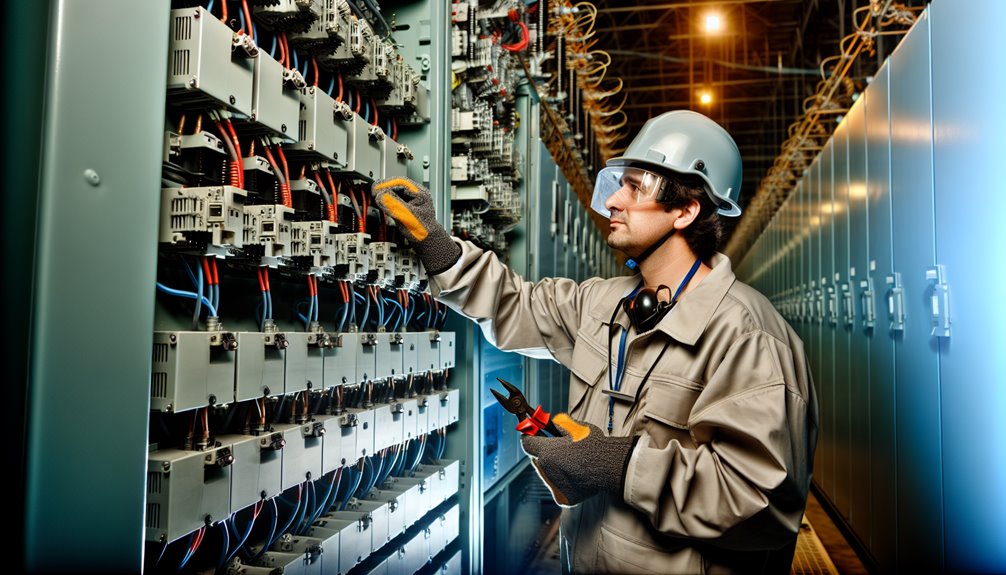
High voltage switchgear maintenance encompasses a thorough range of activities designed to confirm peak performance and longevity of electrical components. This includes hv switchgear preventive maintenance routines, which are meticulously planned to mitigate wear and aging of both mechanical and electrical components.
The maintenance process involves systematic inspections, precise high voltage switchgear testing, and detailed mechanical checks to confirm functionality and safety. Cleaning procedures are implemented to prevent contamination, while environmental controls are adjusted to protect against adverse conditions.
Condition monitoring is essential, employing diagnostic tools to assess the integrity of components and predict potential failures. These practices collectively support the reliability and efficiency of switchgear systems, confirming operational stability and compliance with stringent safety standards.
High voltage switchgear maintenance can be categorized into preventive, predictive, and corrective maintenance, each serving distinct roles in ensuring operational reliability.
Preventive maintenance involves scheduled inspections and servicing to preempt potential equipment failures, while predictive or condition-based maintenance utilizes real-time monitoring and diagnostics to forecast maintenance needs based on equipment condition.
Corrective maintenance addresses identified faults or failures, involving troubleshooting and repairs to restore functionality and prevent recurrence.
Preventive maintenance of high voltage switchgear, although systematic, is vital for guaranteeing operational reliability and extending the lifespan of the equipment. This approach involves scheduled, routine tasks guided by manufacturer recommendations and industry regulations.
Key activities include switchgear condition monitoring and adherence to AIS maintenance guidelines, focusing on inspections, cleaning, and minor adjustments. Inspections are essential for identifying signs of wear, loose connections, and potential arc faults, thereby preventing unexpected failures.
Cleaning prevents dirt accumulation that could impair performance, while adjustments make certain components function within designed parameters. Precise documentation of all maintenance activities is imperative, serving as a reference for compliance audits and future interventions.
Adhering strictly to these practices safeguards system integrity and maximizes switchgear efficiency.
Predictive and condition-based maintenance methods are essential for optimizing the performance and reliability of high voltage switchgear. Through advanced techniques like thermal imaging, partial discharge monitoring, and online monitoring, operators can identify potential failures in gas-insulated switchgear (GIS) systems before they escalate. These methods provide valuable insights, allowing maintenance to be scheduled based on actual equipment condition rather than routine intervals. This approach not only enhances operational reliability but also extends the lifespan of switchgear components. The strategic use of these technologies guarantees a proactive stance in gis switchgear maintenance, minimizing downtime and associated costs.
| Technology | Benefit |
|---|---|
| Thermal Imaging | Detects overheating components |
| Partial Discharge Monitoring | Identifies insulation faults |
| Online Monitoring | Provides real-time equipment data |
Corrective maintenance focuses on addressing issues that arise after the detection of faults, alarms, or abnormal performance in high voltage switchgear systems. This approach is essential for restoring functionality and ensuring system reliability.
Key actions include:
Corrective maintenance is a critical component of high voltage electrical equipment maintenance, ensuring safety and reliability within power distribution systems by addressing issues promptly and effectively.
High voltage switchgear reliability can be compromised by several common issues including overheating and hot spots, which may arise from poor connections or excessive current.
Insulation deterioration, often resulting from prolonged electrical stress or environmental factors, poses significant risks to operational integrity.
Additionally, mechanical wear or sticking mechanisms, environmental contamination such as dust and humidity, and control circuit failures are critical problems that require vigilant monitoring and timely maintenance to guarantee peak performance and safety.
Overheating and hot spots represent significant challenges in the operation of high voltage switchgear, often leading to equipment failure and safety hazards.
To maintain control and guarantee reliability, operators should utilize switchgear thermal imaging to detect abnormal temperature rises early. This proactive approach is crucial for identifying potential issues before they escalate.
Additionally, an arc flash maintenance checklist should be meticulously followed to prevent dangerous flashovers and safeguard personnel.
Insulation deterioration, a pervasive issue in high voltage switchgear, threatens operational reliability and safety. This degradation results from various factors including thermal aging, electrical stress, and environmental conditions such as moisture and contamination.
Over time, these elements compromise the dielectric strength of insulating materials, increasing the risk of partial discharges and insulation failure. The presence of contaminants can exacerbate surface tracking, further accelerating deterioration.
Regular diagnostic testing, such as insulation resistance measurements and partial discharge analysis, is vital to detect early signs of insulation weakening.
Mechanical wear and sticking mechanisms present notable challenges in the maintenance of high voltage switchgear, often compromising its operational efficiency and reliability.
Over time, mechanical components such as hinges, springs, and moving contacts are susceptible to wear, leading to malfunctions. Sticking mechanisms can result in delayed operations or failure to operate, posing risks to both equipment and personnel.
To mitigate these issues, consider the following:
Such proactive measures are critical for preserving the reliability and safety of switchgear systems.
Environmental factors such as dust, humidity, and corrosion are significant challenges that can affect the performance and longevity of high voltage switchgear.
Dust accumulation impairs insulation, leading to potential dielectric failure. Humidity exacerbates insulation degradation by promoting moisture ingress, which increases the risk of electrical tracking and short circuits.
Corrosion, primarily due to chemical exposure or salt-laden air, compromises metal components, weakening structural integrity and connectivity. These contaminants necessitate rigorous environmental assessments and targeted maintenance strategies.
Regular cleaning, dehumidification, and protective coatings are essential to mitigate these risks. Implementing climate control measures and using corrosion-resistant materials further enhance switchgear reliability.
Vigilant monitoring and proactive interventions are critical to ensuring ideal performance and extending the operational life of switchgear systems.
While addressing environmental challenges like dust, humidity, and corrosion is essential for maintaining switchgear integrity, attention must also be directed towards control circuit failures, a prevalent issue in high voltage switchgear systems.
Control circuits are vital for the reliable operation of switchgear, guaranteeing timely opening and closing of circuit breakers. Failures may arise from aging wiring, relay malfunctions, or improper connections.
To mitigate these issues, consider the following:
Such measures enhance overall system reliability and performance.
A thorough maintenance checklist for high voltage switchgear encompasses several critical procedures, including visual and physical inspections, electrical and mechanical testing, and thermal and partial discharge monitoring.
Cleaning and lubrication are also integral to maintaining peak performance and longevity. Each of these tasks is essential for ensuring the reliability and safety of the switchgear, serving to prevent failures and extend the equipment's operational life.
Conducting a thorough visual and physical inspection of high voltage switchgear is essential for ensuring operational integrity and safety. This critical maintenance step helps identify issues such as dust accumulation, corrosion, loose hardware, and moisture ingress, which can compromise performance.
Technicians should meticulously document findings for future reference, noting any deviations from normal conditions.
Thorough electrical testing forms a critical component of high voltage switchgear maintenance, serving as a definitive step in evaluating the operational integrity of the equipment. This testing encompasses several methods, including insulation resistance, contact resistance, hi-pot/voltage withstand, circuit continuity, and relay and protection testing. Each technique is designed to identify potential issues that could compromise switchgear performance and safety.
| Testing Method | Purpose | Frequency |
|---|---|---|
| Insulation Resistance | Evaluates insulation health | Annually |
| Contact Resistance | Detects contact degradation | Every 2 years |
| Hi-pot/Voltage Withstand | Tests dielectric strength | Post-maintenance |
| Relay and Protection | Guarantees proper relay operation | Annually |
Mechanical testing plays a critical role in the maintenance of high voltage switchgear, focusing on evaluating the functionality and reliability of mechanical components. This testing involves examining critical aspects such as open/close speed, interlocks, and latching mechanisms. Identifying and addressing mechanical deficiencies is essential to prevent operational failures and guarantee safety.
These processes are designed to maintain control over operational reliability, extending the lifespan of switchgear systems and safeguarding the power distribution network.
Thermal and partial discharge monitoring are indispensable components of high voltage switchgear maintenance, as they provide critical insights into the operational health of electrical systems.
These monitoring techniques are essential for identifying potential failure points before catastrophic events occur. Infrared (IR) scanning is employed to detect abnormal temperature variations in components, indicative of poor connections or overloading.
Ultrasonic checks complement this by identifying partial discharge activities, which are precursors to insulation breakdown. Regular assessments using these methods enable maintenance personnel to make informed decisions, prioritize repairs, and enhance the reliability of the power distribution network.
Regular cleaning and lubrication are indispensable in maintaining the ideal performance of high voltage switchgear. These tasks prevent the accumulation of dust and debris on enclosures, busbars, switches, and mechanical joints, which can lead to overheating and potential failures.
Lubrication of mechanical joints guarantees smooth operation and reduces wear on moving parts. For best results, it is essential to adhere to a detailed maintenance schedule:
Adhering to these practices fosters reliability and extends the switchgear's lifespan, providing control over operational efficiency.
In the maintenance of high voltage switchgear, the requirements vary considerably among Air-Insulated Switchgear (AIS), Gas-Insulated Switchgear (GIS), and Hybrid or Digital Switchgear.
AIS, typically used in outdoor settings, demands regular inspection and cleaning due to its exposure to environmental elements.
In contrast, GIS, with its compact and sealed design, requires less frequent but more specialized checks to guarantee gas integrity.
Hybrid or Digital Switchgear combines elements from both AIS and GIS, necessitating a tailored approach that considers both traditional mechanical inspections and modern electronic diagnostics.
Air-Insulated Switchgear (AIS) presents unique maintenance requirements that are influenced considerably by environmental conditions. AIS relies on air as an insulating medium and as a result demands diligent attention to environmental factors.
Maintenance focuses on mechanical cleaning to mitigate issues caused by contaminants. It is essential to implement systematic inspection and servicing routines, tailored to specific site conditions. Failure to address these could compromise operational integrity.
Key considerations include:
Although Gas-Insulated Switchgear (GIS) offers a compact and robust alternative to traditional switchgear systems, its maintenance requirements are uniquely specific due to the reliance on SFgas as an insulating medium. Key aspects include SFgas density monitoring, leak detection, and managing sealed compartments. Regular checks guarantee the integrity of the gas seals and the absence of leaks, which could compromise insulation effectiveness.
| Maintenance Task | Frequency |
|---|---|
| SFGas Density Check | Quarterly |
| Leak Detection | Biannually |
| Sealed Compartment Test | Annually |
| Visual Inspection | Annually |
These tasks are critical for maintaining system reliability and safety. The precision in execution and adherence to a documented schedule is essential, guaranteeing GIS operates within suitable parameters, thereby extending its operational lifespan while safeguarding against failures.
Hybrid or digital switchgear offers a modern solution by integrating digital technologies with traditional switchgear components, enhancing performance and monitoring capabilities.
Maintenance for these systems involves specific requirements due to their advanced technology. Key maintenance activities include:
These practices are essential for maintaining the switchgear's reliability and guaranteeing long-term performance.
Failure to adhere to these maintenance protocols can compromise system safety and operational efficiency, leading to costly downtimes.
Maintenance frequency for high voltage switchgear is a critical consideration to confirm peak performance and longevity. Annual inspections serve as a foundational practice, allowing for the early detection of potential issues.
Major testing, occurring every three to five years, provides a deeper evaluation of switchgear integrity. This thorough testing cycle guarantees that any degradation in performance can be addressed before it leads to system failures.
Additionally, maintenance schedules should be condition-based, taking into account load variations, environmental conditions, and utility standards. This approach allows for tailored interventions that are responsive to specific operational demands.
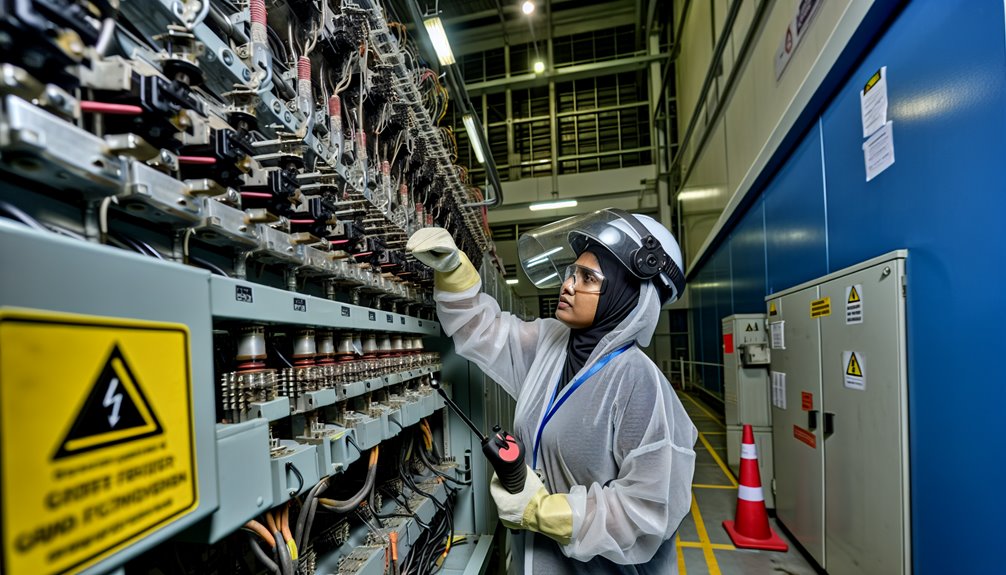
High voltage switchgear maintenance necessitates strict adherence to safety protocols, including thorough isolation and lockout/tagout (LOTO) procedures compliant with NFPA 70E standards.
These procedures are essential to mitigate arc flash risks and guarantee personnel safety, necessitating the use of appropriate personal protective equipment (PPE) and the observance of defined approach boundaries.
In addition, compliance with IEC/IEEE standards is critical to maintaining operational safety and protecting personnel from potential electrical hazards.
In the domain of high voltage switchgear maintenance, the meticulous application of isolation and Lockout/Tagout (LOTO) procedures, as mandated by NFPA 70E, is paramount to ensuring safety.
These procedures are essential in preventing electrical accidents and ensuring maintenance personnel safety. The process involves several precise steps:
Although essential for ensuring the safety of personnel working with high voltage switchgear, arc flash precautions require a detailed understanding of electrical hazards and adherence to stringent safety protocols.
Arc flash incidents pose significant risks, necessitating extensive hazard analysis prior to maintenance activities. This involves calculating potential incident energy levels and establishing arc flash boundaries, thereby minimizing exposure.
Effective risk mitigation includes implementing administrative controls, such as strict adherence to safety procedures and ensuring thorough documentation of all safety measures taken.
Engineering controls may involve the installation of arc-resistant switchgear and fault current limiters.
It is imperative that personnel are thoroughly trained in recognizing arc flash hazards and in implementing protective measures to safeguard themselves and the operational integrity of the switchgear system.
Ensuring safety during high voltage switchgear maintenance necessitates the use of appropriate personal protective equipment (PPE) and adherence to well-defined approach boundaries.
Proper PPE includes arc-rated clothing, insulating gloves, and face shields to mitigate the risk of electrical shock and arc flash injuries.
Approach boundaries, determined by the voltage level and equipment configuration, designate safe distances for personnel, limiting exposure to electrical hazards.
These boundaries are critical for maintaining personnel safety and operational integrity.
To evoke a sense of urgency and importance:
Such precautions empower workers to maintain control over their safety environment.
While adherence to safety standards is paramount in high voltage switchgear maintenance, compliance with IEC and IEEE standards specifically guarantees that procedures meet internationally recognized safety and performance criteria.
These standards provide a thorough framework for evaluating and enhancing the safety, reliability, and operational effectiveness of switchgear systems. IEC standards outline essential guidelines for design, installation, and maintenance, ensuring consistent safety practices across global applications.
IEEE standards complement these by focusing on electrical engineering specifics, offering technical protocols that address the intricacies of high voltage systems. Compliance not only mitigates risks but also facilitates interoperability and quality assurance.
When should a professional be called to assess high voltage switchgear? The decision to engage a professional hinges on critical scenarios where specialized expertise is non-negotiable.
Engage a professional for high voltage switchgear when specialized expertise is non-negotiable.
There are several indicators that necessitate professional intervention:
These conditions threaten the safety and reliability of high voltage systems, emphasizing the necessity of professional evaluation and maintenance to guarantee long-term performance.

In maintaining high voltage switchgear, adherence to best practices is paramount to optimizing performance and guaranteeing safety.
Key strategies include maintaining a thorough asset history log to track maintenance activities and performance trends over time. It is essential to trend test reports, which allows for the identification of emerging issues before they escalate.
Compliance with manufacturer and IEC/IEEE guidelines guarantees that maintenance procedures align with industry standards. Environmental control is critical; adequate measures should be implemented to mitigate environmental impacts on switchgear.
Additionally, leveraging remote monitoring technologies can enhance real-time condition assessments, providing early warnings of potential failures.
These practices collectively contribute to the reliability and longevity of high voltage switchgear systems, ensuring they operate safely and efficiently.
Environmental conditions, like a double-edged sword, can degrade switchgear performance by introducing dust, moisture, and corrosive vapors. These factors necessitate stringent protective measures, including regular inspections and maintenance, ensuring peak functionality and extending equipment lifespan.
Gas-insulated switchgear offers greater space efficiency, reduced maintenance due to protection from environmental conditions, and enhanced reliability. It is better suited for urban settings where space is limited and operational consistency is essential.
A well-maintained spare parts inventory can reduce downtime by up to 30%. Managing inventory involves forecasting demand, ensuring critical components are readily available, following manufacturer's guidelines, and regularly reviewing stock levels to maintain operational efficiency.
Personnel handling high voltage switchgear should undergo thorough training on system operation, safety protocols, emergency procedures, and equipment-specific guidelines. Continuous education and manufacturer-led sessions guarantee proficiency, compliance, and effective maintenance, mitigating risks associated with high voltage environments.
High voltage switchgear protects against high current faults by automatically detecting irregularities, using circuit breakers to interrupt fault currents, and employing protective relays to isolate faulted sections, thereby preventing equipment damage and ensuring personnel safety.
In summary, thorough care of high voltage switchgear is essential for consistent safety and system stability. Routine reviews, rigorous repairs, and resource readiness are critical in vanquishing vulnerabilities and prolonging performance. By following meticulous maintenance measures, electrical engineers guarantee enduring efficiency and equipment efficacy, safeguarding against potential pitfalls. The guide's guidance on professional protocols and precise practices provides a path to proficient, proactive protection. Consequently, diligent dedication to detail decisively diminishes downtime and danger, delivering dependable distribution.
